
Recoverable Belonging: Reconstructing Hungarian Diasporic Continuity Through Archives, Church, and Memory
Harvey Cottrell

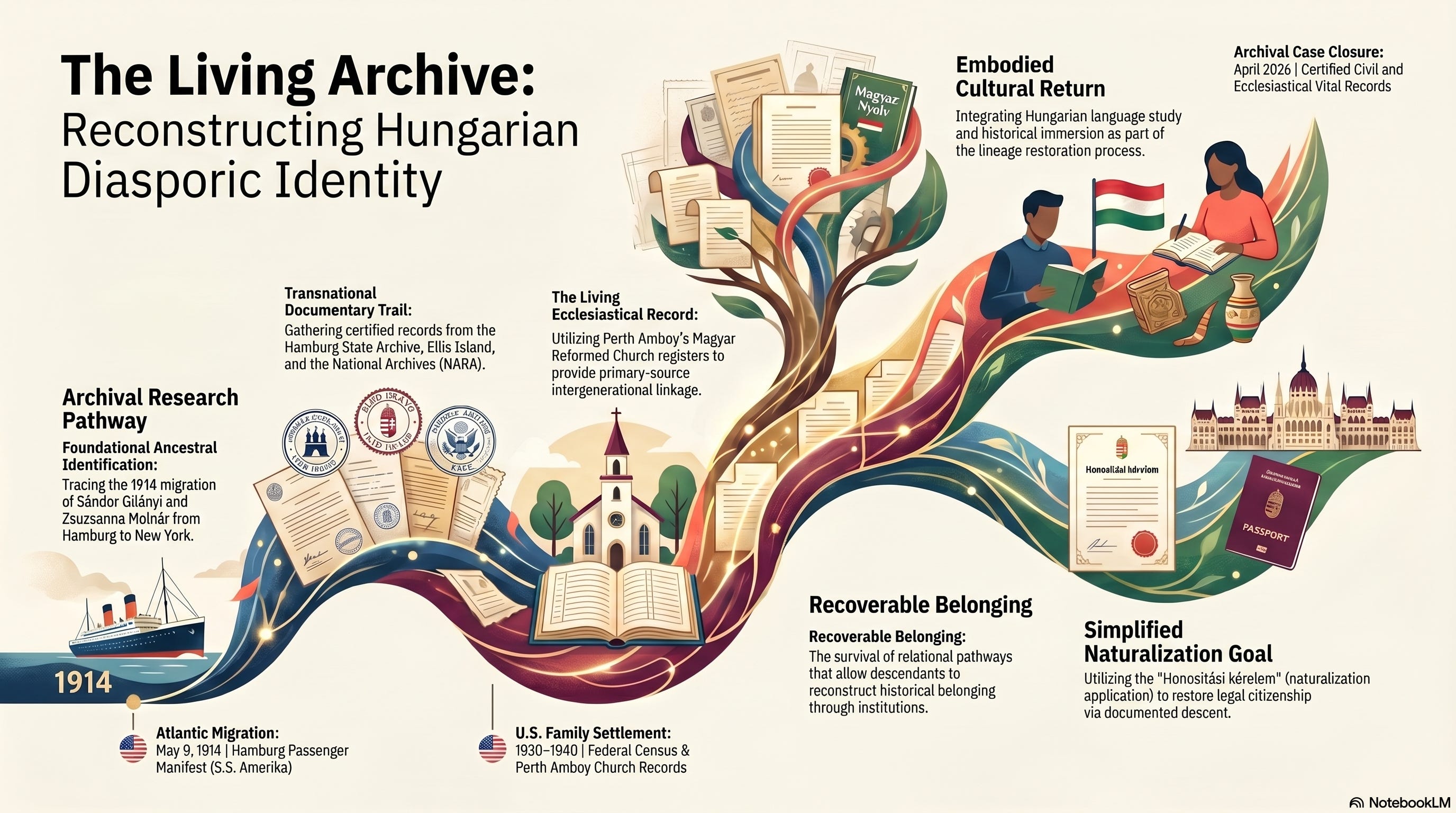
“Recoverable Belonging” emerged in this archive not as a slogan, but as an observation.
At first, the work appeared to be genealogical: locating names, tracing passenger manifests, obtaining baptismal records, and reconstructing a lineage interrupted by migration and time. Yet as the research deepened, another pattern became visible. The records themselves were not acting alone. What endured across generations were not merely surnames or legal documents, but relational structures that continued to carry memory long after migration.
The church remembered.
The registers remembered.
The language remembered.
The community remembered.
The institutions remembered.
Even where the family no longer fully remembered itself, traces of continuity remained embedded within archival systems, ecclesiastical records, liturgical traditions, cemeteries, photographs, naming practices, and diasporic communities.
“Recoverable Belonging” refers to the survival of these pathways.
It is the idea that belonging can sometimes be reconstructed after rupture because certain structures continue to preserve relational continuity across time. These structures may include:
churches,
archives,
language,
rituals,
migration records,
community organizations,
family photographs,
or intergenerational memory.
The concept does not suggest that identity is static or biologically automatic. Nor does it assume that ancestry alone guarantees cultural continuity. Instead, it proposes that belonging survives through networks of preservation, carried by institutions and practices that carry fragments of identity across generations until descendants are able to encounter them again. In this sense, the archive became more than a repository of evidence. It became a site of encounter.
The discovery of a baptismal record was not only administrative; it represented the recovery of a relationship between generations separated by migration, assimilation, and time. The Hungarian Reformed Church in Perth Amboy functioned not merely as a religious institution, but as a continuity structure that preserved names, sacramental records, and communal identity long after the original immigrant generation had died. Language study similarly became more than skill acquisition; it became an embodied attempt to re-enter a historical and cultural world that had not entirely disappeared.
The archive, therefore, revealed a paradox central to diasporic life: rupture and continuity can coexist.
Migration disrupted language, geography, and daily communal life. Yet enough survived within relational systems for reconstruction to remain possible. Belonging was not fully lost. It remained recoverable.
This framework also reframes citizenship itself. Simplified naturalization is often discussed as a legal mechanism, but within this archive, it appears as part of a broader relational process. The legal pathway exists because historical continuity was preserved somewhere: in state registries, church books, migration records, and collective memory. Citizenship restoration therefore becomes not only administrative recognition, but acknowledgment that historical ties endured despite displacement.
“Recoverable Belonging” ultimately describes the lived space between disappearance and continuity. It names the condition in which descendants inherit fragments rather than fullness, yet are still able, through archives, institutions, language, and participation, to reconstruct meaningful connections to a people, history, and cultural world that migration once threatened to dissolve.
Within this archive, belonging was not rediscovered all at once. It accumulated slowly: through correspondence, through records, through language lessons, through church visits, through names written in fading registers, through cemeteries, through songs, through institutions that quietly continued carrying memory forward.
The archive became “living” precisely because it demonstrated that continuity had never entirely ended.
The Living Archive is a long-form ethnographic and archival project documenting the reconstruction of Hungarian diasporic continuity through:
genealogy,
church records,
migration archives,
language acquisition,
cultural participation,
and lived return.
Here you will find:
archival discoveries,
Ellis Island and Hamburg migration records,
Hungarian Reformed church history,
photographs and family materials,
reflections on identity and memory,
Hungarian language learning,
diaspora research,
and the evolving idea of “Recoverable Belonging” — the survival of relational pathways that allow descendants to reconnect with histories thought lost to migration and time.
This is not simply a genealogy project. It is an exploration of what survives across generations: through institutions, through language, through ritual, through archives, and through the people who continue carrying memory forward.
Some entries will read like research notes. Others will feel like field journals, essays, archival fragments, or reflections from within the process itself.
Nothing here is fully separate: the historical becomes personal, the personal becomes scholarly, and the archive itself becomes living.
If you follow this archive, you will witness the process as it unfolds in real time: the discoveries, the dead ends, the correspondence, the records, the language lessons, the church visits, the evolving theories, and the gradual reconstruction of continuity across generations.
You will not only see what was found. You will see how belonging itself is slowly reconstructed through archives, memory, institutions, and participation.
Welcome to The Living Archive.